
Guides · Guide
How AI Citation Ranking Works
Why AI systems retrieve many pages but cite few, and why search rank and schema are not the same as citation.
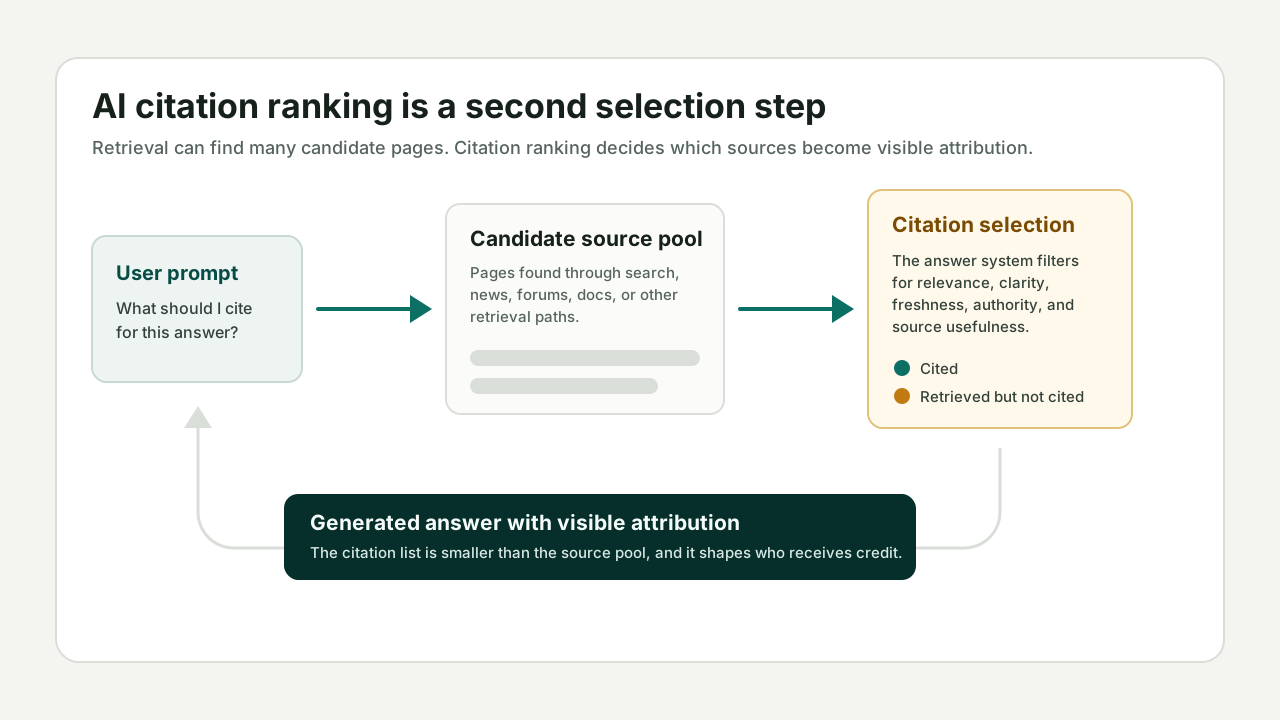
AI citation ranking is the selection step between a page being found and a page being visibly credited in an AI answer.
That distinction matters because AI search does not only return links. A user question can expand into several retrieval queries, a larger candidate pool, a generated answer, and then a smaller set of citations or annotations. A page can sit in that pool without becoming a visible source.
This guide expands an AIvsRank essay, AI Search Is Entering Its PageRank Moment, into an operator model: retrieval is not citation, classic ranking is related but not equal, schema markup is an echo rather than a lever, and query fan-out can enlarge the pool before selection starts.
Four layers operators mix up
| Layer | What happens | What a team can observe | What it does not prove |
|---|---|---|---|
| Query fan-out | One question expands into related retrieval queries. | The answer covers sub-questions the user did not type. | A fixed number of hidden searches on every surface. |
| Retrieval | The system finds or considers candidate URLs. | A URL can be used as context without being shown. | That the URL will be cited. |
| Classic ranking | Search systems order pages for a query. | Position in a results list, when you can see one. | That the same URL will be the visible citation. |
| Citation | The answer exposes a smaller source set. | A URL, card, or annotation next to the claim. | That every sentence came from that URL. |
Google’s public guidance still starts earlier than this table: unique, people-first content, and pages that can be crawled and indexed. Citation ranking is the extra contest after those foundations. It is not a replacement for them.
Retrieval is not citation
Retrieval means an AI system found or considered a source while trying to answer a prompt. Citation means the final answer exposed that source as visible attribution.
Those are different outcomes. How AI citations work covers the evidence rules for a captured URL. This page covers why many retrieved pages never become that URL.
OpenAI’s web search documentation describes search actions and message annotations separately: a response can include a web search call, generated text, and URL citation annotations attached to the final message. OpenAI’s crawler documentation also distinguishes search visibility from training collection by separating OAI-SearchBot from GPTBot.
For content teams, appearing in a search or source pool is only the entry ticket. The next competition is whether the system chooses the page as evidence worth showing.
Query fan-out enlarges the pool
Query fan-out is the operator name for a one-to-many retrieval pattern. The search query or prompt the user typed is not the only lookup the system may run. It can expand that question into definitions, constraints, comparisons, and other sub-questions, then retrieve a wider candidate set.
That is why a page can lose for a prompt it “matches” on the title: the system was also retrieving pages that answer a hidden constraint. It is also why a page can be cited for a prompt that never uses the page’s primary keyword. The useful unit is the job and its sub-questions, not one exact string.
Do not treat third-party query counts as operating constants. Surfaces differ. Logged-in state differs. The durable move is to write pages that answer the likely expansions, then measure a prompt set that includes those variants.
Example: a recommendation prompt about “best inventory tools for a three-person export team” may also retrieve implementation time, integration limits, and category definitions. A slogan page fails those lookups. A dated comparison table that names the job can enter more than one of them.
Counterexample: spinning a new URL for every imagined hidden query. That is how thin content multiplies. One durable page plus a measured prompt set is the operator response.
Why AI systems need a second selection layer
The web is too noisy to cite every retrieved source. A prompt can surface official documentation, marketing pages, old forum threads, news articles, scraped summaries, product reviews, and weak generated pages.
If an answer system treated every retrieved page as equally useful, the answer would become unstable. It needs a filtering layer that asks:
- Is this source relevant to the prompt and the expanded retrievals?
- Is the page clear enough to support a specific claim?
- Is the source stable and attributable?
- Is the information fresh enough for the topic?
- Does the cited page actually support the answer being generated?
This is why the PageRank analogy is useful. Traditional search needed a way to decide which pages mattered in a large web graph. AI search now faces a related problem: which sources deserve attribution inside a generated answer?
The analogy should stay bounded. It does not mean ChatGPT literally uses Google’s PageRank. It means AI search has a comparable class of selection problem.
Search ranking is related, not the same contest
Classic ranking and AI citation often move together because both reward pages that can be found, parsed, and trusted. They are still different contests.
A high position can make retrieval more likely. It does not finish citation selection. A page can rank for the head query and lose the citation if another URL answers the expanded sub-question more clearly. A page can sit outside the first screen of a classic results list and still be cited if it is the cleaner evidence unit.
For GEO work, do not read a rank-tracking screenshot as an AI citation result. Record both. When they diverge, inspect the page as a knowledge unit: title, opening answer, headings, entities, and whether the claim the model needed is actually on the page.
Google’s 2026-05 resource on generative AI features in Search treats this as an extension of existing Search quality work, not a separate trick layer. Unique, non-commodity content still comes first. Citation ranking is how operators describe the later, visible credit.
Schema markup is an echo, not a lever
Schema markup can help machines parse facts that are already on the page. It does not replace a citable answer.
Google’s public AI-experience guidance says structured data is useful when it matches visible content and follows the structured-data guidelines. That is a matching rule, not a citation guarantee. Markup that invents a product, an FAQ, or an organization the page does not show creates a trust leak.
The content citability checklist already treats schema as a machine-readable echo. This page adds the ranking implication: if citations are missing, fix the visible claim first. Then, if you use markup, make it describe the same entities, dates, and offers the reader can see.
| Move | Use it when | Do not expect |
|---|---|---|
| Clarify the opening answer | The page buries the claim | Markup to rescue a vague paragraph |
| Add matching JSON-LD | The visible page already states the entity | A jump in citation rate from markup alone |
| Remove mismatched markup | The schema describes a page that is not there | Search features to “make up” for thin copy |
What makes a page easier to cite
A citable page is not just a page that mentions the right keyword. It is a durable knowledge unit.
Strong candidates usually have:
- a title that names the problem or question;
- a URL slug that carries semantic meaning;
- an opening that states the core answer clearly;
- headings that map to the user’s likely sub-questions, including fan-out variants;
- definitions, comparisons, data, examples, or procedures that can be attributed;
- visible dates or review metadata when freshness matters;
- claims that the cited page actually supports.
Weak candidates often have the opposite shape: vague titles, generic intros, buried conclusions, unsupported claims, stale facts, or mixed-topic essays that are hard to classify.
Google’s 2025 guidance on AI experiences on Search still requires the earlier access bar: the page must be findable, crawlable, and indexable, including a successful HTTP response. Preview controls such as noindex or nosnippet also limit how content can appear in AI formats. Citation ranking cannot start if the page is not eligible to be read.
Freshness helps, but it is not enough
Freshness matters most for news, pricing, regulation, product releases, and fast-changing technical documentation.
A new page can still fail citation selection if it does not answer the relevant sub-question. An older page with a stable URL, clear structure, and strong support for a claim can remain useful.
For GEO work, the goal is not to publish faster for its own sake. The goal is to turn a judgment into a page that can be recognized, reused, and attributed over time.
Citations do not guarantee correctness
Visible citations improve traceability, but they do not make an AI answer automatically correct.
An answer can cite a real page and still misread it. It can attach a source that does not support the specific claim. The Tow Center for Digital Journalism has documented cases where ChatGPT Search struggled to identify publisher information accurately, which is a reminder that citations need verification, not blind trust.
For teams measuring AI visibility, this creates two parallel checks:
- Did the answer cite us or a trusted source?
- Did the cited source actually support the answer?
Both matter. Source attribution is the second check.
How to diagnose a missed citation
Use the layer that actually failed. Do not start a rewrite until you know which row you are in.
| Observation | Likely layer | Next check |
|---|---|---|
| Ranked for the head query, not cited | Citation selection or claim fit | Does the page answer the sub-question the model needed? |
| Not visible in classic results, still cited | Retrieval via fan-out or another index | Which prompt variant would retrieve this URL? |
| Retrieved or mentioned, no owned URL | Citation selection | Is there a durable, attributable page for the claim? |
| Cited, claim wrong | Attribution quality | Does the cited paragraph support the sentence? |
| Schema added, citations unchanged | Markup is not the lever | Fix the visible answer, then recapture. |
| Page blocked or unindexable | Access | Status code, robots, and indexability before content edits. |
Run the same prompt set more than once before you treat a missing citation as a permanent gap. Then change one source cluster and recapture. The method lives in how to measure AI visibility.
As of 2026-06-03, Google began rolling out dedicated Search Console views for generative AI feature impressions, including AI Overviews and AI Mode, to a subset of sites. That is a dated measurement signal, not a substitute for prompt-level citation records. Confirm whether your property has the report before you treat it as a KPI source.
Operator checklist
Use this checklist when improving a page for AI citation ranking:
- Confirm the page can be crawled and indexed, and that preview controls are not hiding the answer.
- State the core question in the title or opening.
- Use a natural-language slug that reflects the page’s real topic.
- Put the direct answer near the top.
- Break the page into sections that match likely buyer or research sub-questions, including fan-out variants.
- Add definitions, tables, examples, and decision criteria where they clarify the answer.
- Keep dates, review metadata, and vendor claims current. Mark unverified vendor details as unknown.
- If you add schema, make it match the visible page. Do not use it as the optimization.
- Avoid unsupported marketing language.
- Check whether cited sources in AI answers actually support the generated claim.
- Track citation outcomes across a repeatable prompt set, not one manual chat. Do not treat a rank-tracking screenshot as the citation result.
The measurement implication
Citation ranking turns GEO from a writing problem into a measurement problem.
The useful question is not only “can this page rank?” It is:
Can this page be found, understood, selected, cited, and attributed?
That requires recurring prompt tracking, citation tracking, competitor comparison, and source-level review. When a competitor is cited and your page is not, inspect the gap by layer: access, title alignment, URL clarity, answer completeness, fan-out coverage, freshness, and whether your page supports the claim the model needed to make.
That is where an AI visibility workflow becomes useful. It turns citation ranking from a vague content theory into a set of measurable outcomes.